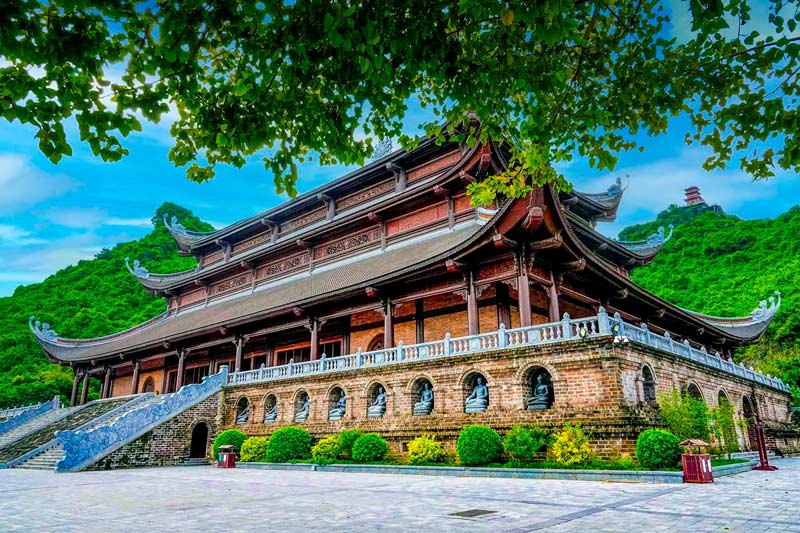
Vietnam is home to many beautiful Buddhist temples that reflect the country’s long history and rich cultural traditions. These sacred places attract both local worshippers and travelers who want to learn more about Buddhism and Vietnamese heritage.
From ancient pagodas to large modern temple complexes, each destination has its own unique charm. If you enjoy history, architecture, or peaceful surroundings, these Buddhist temples are well worth adding to your Vietnam travel itinerary.
1. Bai Dinh Pagoda (Ninh Binh)
Bai Dinh Pagoda is the largest Buddhist temple complex in Vietnam and one of the most impressive religious sites in Southeast Asia.
Located about 15 kilometers (9 miles) from the famous Trang An Landscape Complex, the sprawling complex covers hundreds of hectares and features magnificent halls, beautiful courtyards, and thousands of stone Buddha statues.
Highlights include a massive bronze Buddha statue, a towering bell tower, and long corridors lined with hundreds of Arhat statues. Visitors can also climb to higher viewpoints for panoramic views of the surrounding limestone mountains.
Bai Dinh is especially busy during the Lunar New Year and spring festival season when thousands of pilgrims visit to pray for good fortune.
2. Perfume Pagoda (Hanoi)
The Perfume Pagoda is one of Vietnam’s most sacred Buddhist pilgrimage sites.
Rather than a single temple, it is a complex of temples, shrines, and caves built into the Huong Son Mountains, about 60 kilometers (37 miles) southwest of Hanoi.
Reaching the main temple is part of the adventure. Visitors first take a scenic boat ride along the Yen River before walking or riding a cable car up the mountain.
The main shrine, Huong Tich Cave, features naturally formed rock formations and peaceful Buddhist altars that have attracted pilgrims for centuries.
3. One Pillar Pagoda (Hanoi)
One Pillar Pagoda is one of Vietnam’s most iconic landmarks and one of the country’s oldest Buddhist temples.
Originally built in 1049 during the Ly Dynasty, the pagoda stands on a single stone pillar rising from a small lotus pond. Its unique design resembles a lotus flower blooming from the water, symbolizing purity in Buddhism.
Although relatively small, the pagoda carries great historical and cultural significance and remains one of Hanoi’s most photographed attractions.
Its location near Ho Chi Minh Mausoleum makes it easy to visit while exploring the capital.
4. Linh Ung Pagoda (Da Nang)
Perched on the Son Tra Peninsula, Linh Ung Pagoda offers both spiritual beauty and spectacular coastal views.
The temple is best known for its towering 67-meter (220-foot) statue of the Lady Buddha, the tallest statue of its kind in Vietnam. Overlooking the East Sea, the statue is believed by many locals to protect fishermen and bring peace to the region.
Visitors can stroll through beautifully landscaped gardens, admire intricate Buddhist sculptures, and enjoy panoramic views of Da Nang’s coastline.
The peaceful atmosphere makes Linh Ung one of the city’s most popular attractions.
5. Vinh Nghiem Pagoda (Ho Chi Minh City)
Vinh Nghiem Pagoda is one of the largest and most important Buddhist temples in Ho Chi Minh City.
Completed in the 1970s, the temple blends traditional Vietnamese architecture with modern construction techniques. Its seven-story stone tower and beautifully carved wooden interiors attract both worshippers and tourists.
The spacious grounds provide a peaceful escape from the busy streets of the city, especially during major Buddhist festivals.
Visitors are welcome to observe daily prayers and admire the temple’s elegant design.
6. Thien Mu Pagoda (Hue)
Thien Mu Pagoda is one of the oldest and most famous Buddhist temples in Vietnam.
Situated on a hill overlooking the Perfume River in Hue, the pagoda has become one of the city’s most recognizable symbols.
Its seven-story octagonal tower, known as Phuoc Duyen Tower, was built in the mid-19th century and remains an iconic landmark.
The temple complex also features beautiful gardens, historic buildings, ancient bells, and peaceful courtyards that invite quiet reflection.
Many travelers combine a visit to Thien Mu Pagoda with a boat cruise along the Perfume River.
7. Truc Lam Zen Monastery (Da Lat)
Surrounded by pine forests and overlooking the picturesque Tuyen Lam Lake, Truc Lam Zen Monastery is one of Vietnam’s largest Zen Buddhist monasteries.
Unlike many historic pagodas, this monastery offers a tranquil environment focused on meditation and mindfulness.
Visitors can explore beautifully maintained gardens, admire colorful flower displays, and enjoy breathtaking lake views.
A cable car connecting Da Lat city center to the monastery provides one of the most scenic journeys in the region.
8. Ba Den Pagoda (Tay Ninh)
Located on Ba Den Mountain, the highest peak in southern Vietnam, Ba Den Pagoda has become one of the country’s most impressive spiritual destinations.
The mountain is home to several temples and shrines, many of which have welcomed pilgrims for hundreds of years. In recent years, the area has also gained international attention for its enormous Buddha statues and modern religious architecture.
Visitors can reach the summit by hiking or taking a cable car, where they are rewarded with sweeping views of the surrounding countryside.
The combination of mountain scenery and sacred temples makes Ba Den a memorable destination for both pilgrims and tourists.
Tips for Visiting Buddhist Temples in Vietnam
To ensure a respectful and enjoyable visit, keep these simple guidelines in mind:
- Dress modestly by covering your shoulders and knees.
- Remove hats before entering temple buildings.
- Speak quietly and avoid disturbing worshippers.
- Ask permission before photographing monks or religious ceremonies.
- Remove your shoes if requested before entering certain areas.
- Avoid touching sacred statues or religious objects.
- Consider making a small donation to help support the temple.
Following these customs shows respect for local traditions and enhances your overall experience.
Final Thoughts
Visiting Buddhist temples is a great way to experience Vietnam’s culture and traditions. Each temple offers its own blend of history, beautiful architecture, and a peaceful atmosphere that leaves a lasting impression.
As you explore different regions of Vietnam, be sure to include some of these remarkable temples in your travel plans. They offer a deeper appreciation of the country’s spiritual heritage and are among Vietnam’s most memorable attractions.
